The Helplessness Was Never Learned
A fifty-year scientific mistake, an Australian counter-record, and the five moves that teach control
Good evening, reader.
Editor's note:
A reader has spent the past fortnight among academia and the public sector wrote to us about how common learned helplessness has become there (a settled conviction that nothing an individual does can change direction or outcomes). A second reader asked the obvious follow-up: where did they learn it?
The answer turns out to be stranger than either question assumes, and it comes from the two scientists who invented the term.
In today's Innovation Commons:
The science reversed itself. In 2016 the researchers who named learned helplessness found their 1967 theory backwards: passivity is the unlearned default, and control is the skill that gets acquired (Maier and Seligman, Psychological Review).
The Australian counter-record runs deeper than the display cabinet: a converted asylum pantry that produced the first drug for any mental illness, a hearing-aid laboratory that gave the world obstetric ultrasound, and a central bank that ran a twenty-year secret materials program.
The protocol: five moves that manufacture experienced control at any desk, none of which requires a chair, a grant or anyone's permission.
We are opening a standing repository of the counter-record. Six fact-checked seed entries below; nominations invited by reply.
The dogs that lay down
In 1965, in a basement laboratory at the University of Pennsylvania, two young psychologists watched dogs do something that made no sense. The animals had earlier been exposed to shocks they could not stop. Now, placed in a shuttle box where escape required only a step over a low barrier, most of them did not take it. They lay down. Dogs with no such history jumped the barrier in seconds.
Martin Seligman and Steven Maier published their explanation in 1967, and it became one of the most cited ideas in psychology: the dogs had learned that nothing they did mattered, and the learning itself produced the passivity. They called it learned helplessness. The term escaped the laboratory within a decade, and it now turns up in management decks, education policy and (as our correspondent can attest) the tea rooms of Australian universities and government departments, where it describes people who arrived ambitious and stopped trying somewhere around their third restructure.
Our correspondent's diagnosis of how institutions produce the condition is worth quoting: limited, direct and specific feedback demonstrating the impact of an individual's work, coupled with cultures of scapegoating, agency minimised and risk-taking discouraged. And our second reader asked the question the diagnosis begs: where was it learned? At work, by being shot down, or in childhood?
For fifty years the field would have accepted any of those answers. Then the two men who invented the term took all of them back.
The theory runs backwards
In 2016, Seligman and Maier published Learned Helplessness at Fifty in Psychological Review and reversed their own theory. Five decades of neuroscience had mapped the machinery, and the machinery ran the other way. Passivity under prolonged adversity is not learned at all. It is the default, driven by ancient circuitry in the brainstem that actively suppresses escape. What gets learned is control: a region of the prefrontal cortex learns to detect that an action changes an outcome, and when it detects that contingency, it switches the passivity off.
Nobody taught your colleagues helplessness. It required no teacher, no trauma, no formative defeat. It is the factory setting, and what their institutions failed to do, year after year, is teach control.
Nobody teaches helplessness. It is the factory setting. What gets taught, or not taught, is control.
Maier and Seligman's 2016 reversal, applied to institutions
Read the correspondent's diagnosis again as an engineer rather than a counsellor and it stops being a list of morale problems. It is a list of severed feedback loops. No feedback means the contingency between act and outcome is invisible. Scapegoating attaches outcomes to the wrong person. Minimised agency removes the available acts. Discouraged risk removes the experiments. Four different ways of guaranteeing the control-detection circuitry never fires.
The 2016 paper carries one more finding, and it is the one to sit with. Control, once experienced, inoculates. Subjects that first learn an action works stay active through later adversity that flattens the untrained. The reps compound, which means the condition in our universities and departments is not a life sentence. It is a training deficit.
The counter-record
If control is taught, someone in this country must have taught it. Someone has, repeatedly, and the record is specific enough to fact-check. The pattern is always a pair: a person with an idea, and an institution that made the contingency between act and outcome visible, repeatable and safe to test.
You already know the display cabinet: the CSIRO Wi-Fi patent, Cochlear, Gardasil, the spray-on skin, the quantum lab at UNSW. The trouble with the display cabinet is that it has stopped teaching. Wallpaper does not instruct. The record runs deeper, into rooms nobody photographs.
Start in a converted pantry. In the late 1940s John Cade, superintendent of the Bundoora Repatriation Mental Hospital, was injecting guinea pigs with the urine of manic patients in a disused ward kitchen, chasing a hypothesis nobody had asked for. The Victorian mental hygiene system's grant of control was thin (patients, a pantry and licence to try) but it was real. Cade took lithium himself before giving it to ten patients, and his September 1949 paper in the Medical Journal of Australia delivered the first effective drug for any mental illness. The record keeps its honesty: his first patient later died of lithium toxicity, and the world only caught up around 1970 through Danish trials. Psychopharmacology was founded on the thinnest institutional backing on this list.
In Sydney, a federal laboratory built in 1943 to fit hearing aids to deafened veterans let its physicists chase a sideline. From 1959 the Commonwealth Acoustic Laboratories backed George Kossoff, David Robinson and the obstetrician William Garrett to build imaging machines; their fetal images were state of the art by 1962, and from 1970 the team delivered grey-scale ultrasound, a world first the entire field adopted. Every pregnancy scan on earth descends in part from a hearing-aid lab whose director permitted a detour.
The famous version of CSIRO's story involves a Wi-Fi patent. The more instructive one is its ON program, which since 2015 has run publicly funded researchers through the full loop of testing ideas on real users, producing 52 companies and 226 jobs before being shut down in 2019 and revived in 2022. Institutional memory of how to teach control is, it turns out, also contingent.
At the University of Sydney in 1980, Colin Sullivan built the first continuous positive airway pressure machine partly from a reversed vacuum-cleaner blower and tested it overnight on a consenting patient. The university gave him the world's first sleep apnoea clinic, a workshop to hand-build machines for his patients, and a business office that refused a 1985 American buyout to hold out for an Australian company. That company became ResMed in 1989, and CPAP became the standard of care for a condition whose previous treatment was a tracheostomy.
And when quality forgeries of the new $10 note appeared within a year of decimal currency, Reserve Bank governor H.C. Coombs turned to science: a 1968 think-tank at Thredbo, then a secret research program he kept funding for two decades. David Solomon's team solved the technical problems inside ten years; banking conservatism delayed the world's first polymer banknote until the bicentennial $10 of 1988. The technology now runs in more than fifty countries. A central bank as a patient, covert venture funder is the least likely entry on this list, which is rather the point.
The record also holds a control case, in both senses. David Warren, a fuels chemist at Melbourne's Aeronautical Research Laboratories, invented the flight recorder in the mid-1950s and was told to drop it and get back to fuels. One manager, Tom Keeble, backed him long enough to circulate a memo; a visiting British official saw the prototype in 1958 and flew Warren to London within days. The design was never patented, licensing talks collapsed, and Britain's S. Davall and Sons took the world market with the red egg¹ while ARL never earned a cent. Australia became the first country to mandate the device, in 1963, and built none of the industry. One severed loop, one lost industry.
The protocol
You cannot vote yourself a Reserve Bank research program. You do not need to. Strip the counter-record to its mechanics and five moves repeat, and every one of them scales down to a desk. None requires a chair, a grant or anyone's permission, and each repairs one severed loop from the diagnosis.
First, shrink the unit of work until consequence is undeniable. Most institutional work is sized so that no individual can observe their own effect, which means the training signal never fires regardless of effort. Reverse it: every fortnight, ship something whose outcome you can watch and attribute. The test is simple and brutal. If you cannot name who will notice, it is too big. Cut scope until you can.
Second, close the loop in public. The feedback deficit is the first item in the diagnosis, and you can repair it locally without asking anyone: instrument what your team ships, then send one page with three numbers to the people who did the work, every week. Nobody will stop you, because reporting your own results is not a permission anyone holds.
Third, attach consequence accurately inside your radius. You cannot fix the culture, but for everything your team controls you can run reviews with a fixed script: the timeline, what the system permitted, one change. Ban the question of who until the first two are answered. Your patch of the institution becomes the one place where the signal is clean.
Fourth, size the wagers. Risk-taking is discouraged wherever downside is unbounded and unowned, so bound it and own it: a one-page memo with a cost cap, a named owner, a decision date and kill criteria, taken to whoever can say yes. Both outcomes pay. A yes buys a rep of experienced control. A no to a bounded, owned, dated wager is high-grade information about where you work, gathered at zero cost.
Fifth, keep a ledger of exercised control where the team can see it: date, act, outcome. Read it when the default reasserts, because it will. The second-strongest training signal after experiencing contingency is watching someone within reach experience it, and one visible entry recruits the next author.
This reading comes with a falsification test. Ask your institution to name the last time a mid-level person changed its direction and was rewarded for it. If a name comes back inside a minute, the diagnosis does not apply where you work, and you should act accordingly. If the room goes quiet, you now know precisely which loops are severed, and in what order to repair them. Run the protocol for two quarters before concluding anything.
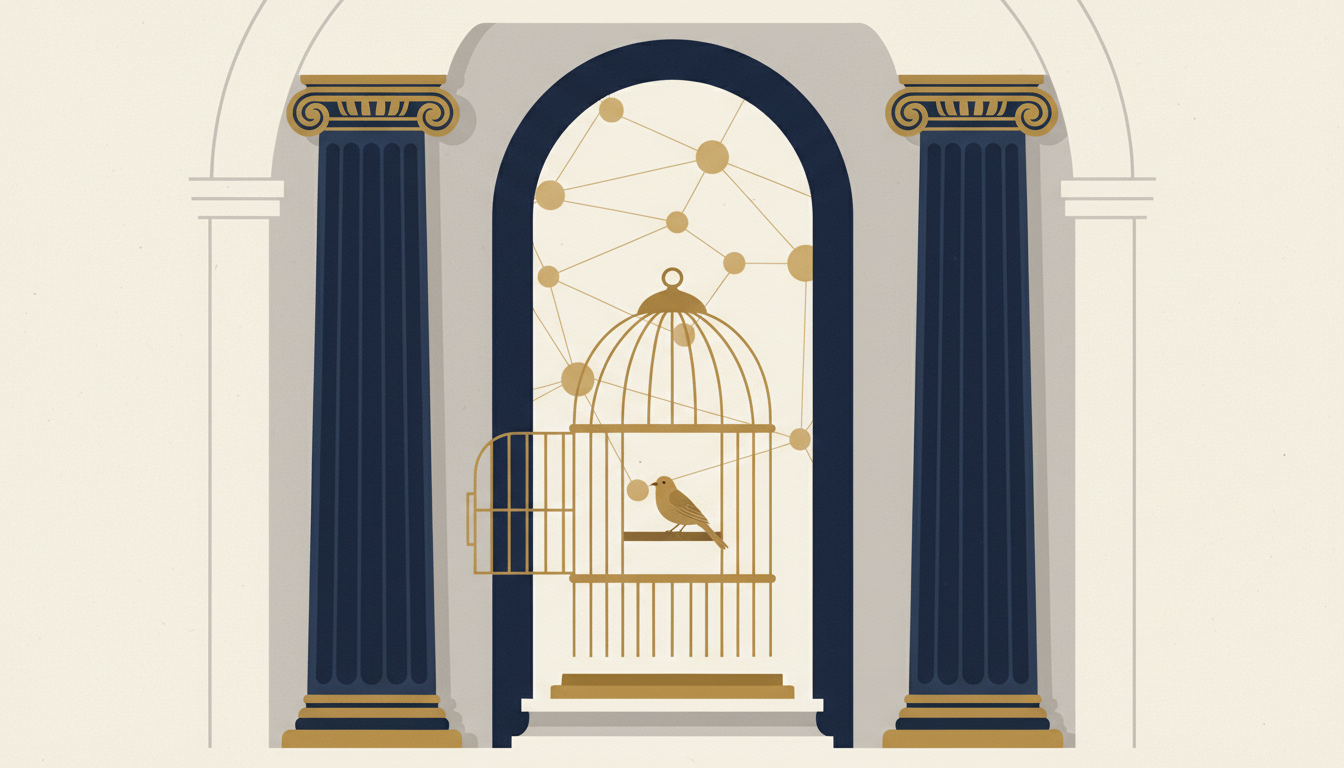
The cage door in this week's illustration is open. It was always open. The bird is not staying because it learned it cannot leave; it is staying because nothing ever taught it that wings work. Wings are taught by flying small distances first. Start with a fortnight, and something someone will notice.
— The Editor
¹ The "black box" is, and has always been, bright orange.
P.S. Share on LinkedIn and X to spark conversations